
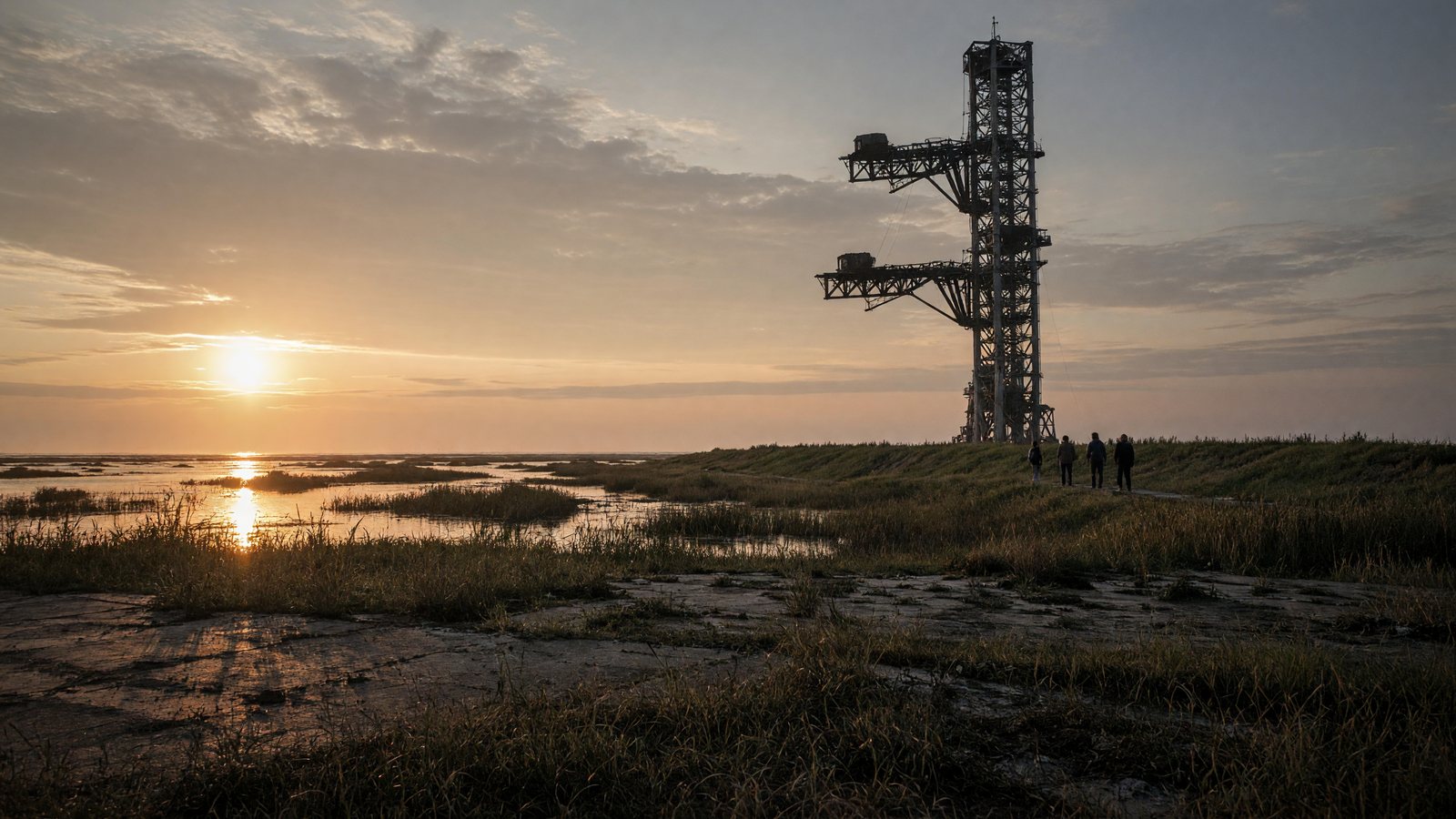
This Starship Flight 15 checklist shows which burns, catches, and safety gates to watch, and how to read a tower catch, a Gulf splashdown, or a scrub. SpaceX has published a 13 November window for the first attempt to recover Super Heavy and the ship at one tower; the booster catch is planned near T+6:35, while Starlink deployment starts only from about T+35:01. A planned catch can still be waved off, and a catch does not prove rapid reuse.
Updated November 8, 2026
Key Takeaways
- The launch window is 75 minutes on 13 November, from 4:45 p.m. CST.
- Booster catch is near T+6:35; the ship catch is near T+22:32:34.
- The ship enters orbit only after a go, then faces later return checks.
- A catch does not prove rapid reuse; inspection and reflight still follow.
What should you check before the window opens?
Treat liftoff as a window, not a fixed time. The Space Road, citing SpaceX’s mission page, lists 13 November, 4:45–6:00 p.m. CST (22:45–00:00 UTC), a 75-minute window. Watch that page or X @SpaceX, and do not book non-refundable travel.
On an October earnings call, Gwynne Shotwell said:
We have had significant constructive engagement with the FAA, and we expect the license for our Flight 15 to include return to launch site and tower catch for both stages.
Ars Technica noted the return crosses land, including northern Mexico. As of the November mission page, launch was still pending regulatory approval. FAA-approved return conditions are not that license.
SpaceX lists Pad 2 and previously named Ship 42. Next Spaceflight expects Booster 22; the new mission page does not name the booster. This is the first V3 booster catch attempt and the first ship catch attempt.
Which burns and catches should you watch on Starship Flight 15?
The catches are more than 22 hours apart. Super Heavy does not orbit; the ship returns only if cleared. At window open, ship catch is about 3:17 p.m. CST on 14 November (21:17 UTC).
These are approximate elapsed times from SpaceX, as listed by The Space Road.
| Event | Elapsed time |
|---|---|
| Hot staging and separation | T+2:21 |
| Booster boostback | T+2:26 to T+3:02 |
| Booster landing burn and catch | T+6:10 burn; T+6:35 catch |
| Orbital insertion, if cleared | T+26:10 to T+26:30 |
| Starlink deployments | T+35:01 to T+1:17:40 |
| Ship catch and shutdown | T+22:32:34 |
Mark checks at T+1:27:46, T+7:15:35 and T+20:41:55. If cleared, deorbit is T+21:35:57, entry T+22:10:46, landing burn T+22:32:16 and flip T+22:32:18, with engines dropping from three to two, then one. The ship is planned near 275 km. Wikipedia describes a coast of about 21 hours and roughly 14 orbits.
What safety gates can call off a return?
Ascent starts on a passively safe suborbital path into a cleared Indian Ocean area and enters orbit only after a go. Hawaii and Chile options can end an orbital flight early.
Before a Starbase return, controllers check heatshield imagery from three camera-carrying Starlink satellites, plus Raptor engines, power, communications, flight computers, navigation sensors, propellant tanks and feedlines, tank pressure and attitude control. If cleared, the ship approaches from the west, avoids major Rio Grande Valley cities, passes north of South Padre Island and turns back to the Pad 2 tower. People nearby may hear sonic booms. No-go options include tumbling the ship so it burns up, a late ocean divert, and a Gulf splashdown for the booster.
What does a catch, splashdown, or scrub change?
- Score ascent, deployment of 26 Starlink V3 satellites and each catch separately. A booster catch alone is not a dual catch.
- Treat a called-off catch as a safety decision, not a guaranteed result. The booster backup is an offshore Gulf splashdown.
- Do not treat a catch as proof of rapid reuse. Inspection, repairs and a reflight still have to follow.
- Do not read Flight 15 as a crewed Moon landing or an HLS demonstration.
Musk has said success is “more likely than not” for these catch attempts, and that SpaceX is hardware rich if there are failures. In this reading, a dual catch shows both stages can reach one tower on a single flight, but cadence still depends on inspection and reflight. A divert uses a published contingency. A scrub leaves the vehicles unflown.
Ars also reported plans to roll out up to 10 GW of ground compute in 2027, while Starlink and a later Starmind constellation still need Starship. For related credit news, see the SpaceX GPU debt deal.
Frequently asked questions
When is the Starship Flight 15 launch window?
SpaceX lists 13 November, 4:45–6:00 p.m. CST (22:45–00:00 UTC), a 75-minute window, not a fixed liftoff. Launch was still pending regulatory approval.
Where should you watch the webcast?
Use SpaceX’s official mission page or X @SpaceX. Coverage starts about 30 minutes before liftoff and is planned through the ship catch.
What if a catch is called off?
The booster can splash down offshore in the Gulf of Mexico. If the ship is not cleared for orbit, it targets a cleared Indian Ocean area; in orbit, it can divert near Hawaii, off Chile, or to the ocean late.
Does a dual catch prove rapid reuse?
No. Ascent, deployment and each catch are separate milestones, and rapid reuse still needs inspection, repairs and a reflight. Flight 15 is not a crewed Moon landing or an HLS demonstration.
