
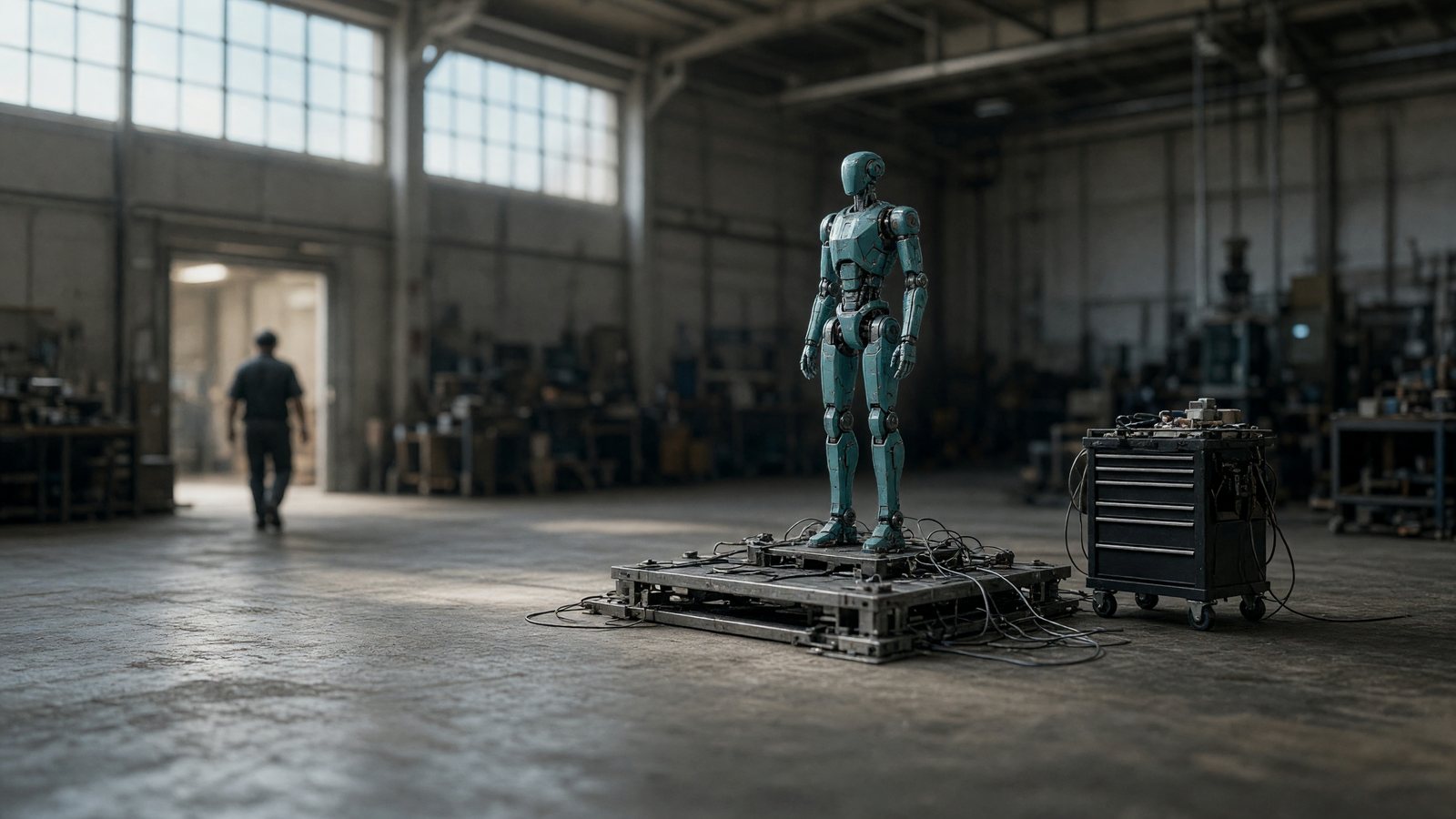
Agility Robotics Nasdaq trading was set to open on November 5, 2026, under the ticker AGLT, after a SPAC close that makes the company the first US publicly listed pure-play humanoid robotics firm. The merger with Churchill Capital Corp XI, completed November 4, is expected to raise about $465 million in gross capital before expenses at a $2.5 billion pre-money valuation.
Key Takeaways
- Agility was set to trade on Nasdaq as AGLT after its SPAC close.
- Gross proceeds are about $465 million at a $2.5 billion pre-money value.
- Digit 5 orders exceed $300 million but hinge on milestones and features.
- 2025 revenue was $1.8 million against a $138.1 million net loss.
How the Agility Robotics Nasdaq Deal Was Built
Agility, a 2015 Oregon State University spinout, skipped a traditional IPO roadshow. It merged with Churchill Capital Corp XI, led by former Citigroup executive Michael Klein, whose earlier deals include Lucid and Oklo, Business Insider reported.
Gross proceeds of about $465 million break into three parts, Crypto Briefing reported: $164 million from the SPAC trust, about $201 million from a Foxconn-led PIPE, and $100 million in prior equity already received. Existing shareholders rolled 100% of their equity into the combined company.
Daniel Diez, chief business officer, told MarketWatch, “We wanted that first-mover advantage.” He added, “It also allows us to set the bar” in an industry known for “hyperbole.” CEO Peggy Johnson told Business Insider, “There’s something to be said for being first.” She added, “We will be able to set many of the metrics, if you will, on what customers need in a humanoid.”
Agility said it had “every option available to us,” including a new private round, but called the SPAC the “fastest, most capital-efficient” route. Scott Walter of RoboStrategy told MarketWatch he sees “red flags on top of red flags on top of red flags.” He said a SPAC can indicate that a company isn’t able to raise sufficient funds in the private market.
Digit Deployments and Conditional Orders
Digit is a bipedal robot for warehouses and factories. It has logged more than 65,000 operating hours across nine customer sites, including Amazon, GXO, Toyota, and Schaeffler. Backers include Amazon, Foxconn, Nvidia, SoftBank, and DCVC. Amazon started tests in 2023 moving empty totes, TechSpot reported, and GXO has deployed it at a warehouse serving Spanx.
GXO said last month it would expand the partnership, citing the technology’s “ability to create measurable value for our customers and a better working environment for our teams.” Agility sells access through robot-as-a-service subscriptions. A filing says more than 30 customers are in $500,000 pilots or commercial discussions.
Digit 5 is built to work near people without the safety barriers earlier models needed. Business Insider said filings describe more than $300 million in orders for 1,000 robots from one customer over three years, but only if deadlines and features are met. Early access is aimed at the first half of 2027, with general availability by year-end. New capital is earmarked for RoboFab, with a plan to enable production of up to 10,000 units a year.
George Chowdhury of ABI Research told Business Insider, “Agility is unique to the industry because they’re actually deployed.”
Revenue, Cash Use, and the Loss Profile
Merger filings show $1.8 million in 2025 revenue and a $138.1 million net loss. More than half the revenue came from five robots an investor bought. About $38 million of the loss was non-cash stock compensation. Cash used to run the business was $99.8 million, and the company lost $2.7 million on sales before research and other costs.
First-half 2026 figures reported by MarketWatch show how little has been recognized:
- Net sales of $174,000, down 72% from a year earlier, attributed to one-time robot sales in the first half of 2025.
- Cost of goods sold up roughly 110%, to nearly $3.9 million.
- An operational loss of $362.7 million, versus $72.6 million a year before, with a significant share tied to stock-based compensation.
- Cash and equivalents of $14.7 million as of June 30, plus $7.1 million in restricted cash, and $544,832 in performance obligations expected as revenue within 12 months.
The company wrote, “Agility is an early-stage company with a history of net losses, and it expects to incur significant expenses and continuing losses for the foreseeable future.”
Humanoid Valuations: Public Marks vs Private Peers
Chowdhury told Business Insider, “This is a trend we’re seeing, where companies with deployments who are actually shipping hardware today are valued by the market a lot lower than companies that are betting on this future.”
| Company | Reported value | Status |
|---|---|---|
| Agility Robotics | $2.5 billion pre-money | Nasdaq, AGLT |
| Apptronik | About $5.5 billion | Private |
| Neura Robotics | Around $7 billion | Private |
| Figure AI | About $39 billion | Private |
| Unitree | Around $40 billion | Shanghai listing |
Tesla’s Optimus has no standalone valuation. In July the FCC banned new foreign-made “advanced robotic devices,” including humanoids, which Business Insider said could give US manufacturers an edge. Agility builds Digit in Oregon. Johnson said, “It’s good for the US to show strength in this area.”
Chinese firms accounted for about 90% of humanoid shipments last year, according to Omdia. TechSpot, citing Reuters, reported that Unitree’s Shanghai shares surged more than fivefold before falling 55% from their peak. Authorities were also scrutinizing whether sales tied to government-backed robot training centers reflected sustainable demand. Investors comparing listed humanoids can also weigh Unitree’s failed Hangzhou flip.
Michelle Sun told Business Insider, “There’s a lot of challenges when it comes to solving unit economics.” Business Insider reported that Sun said the listing would provide a reference point for how public markets value a company that makes humanoids, a form factor that remains controversial among both experts and investors.
