
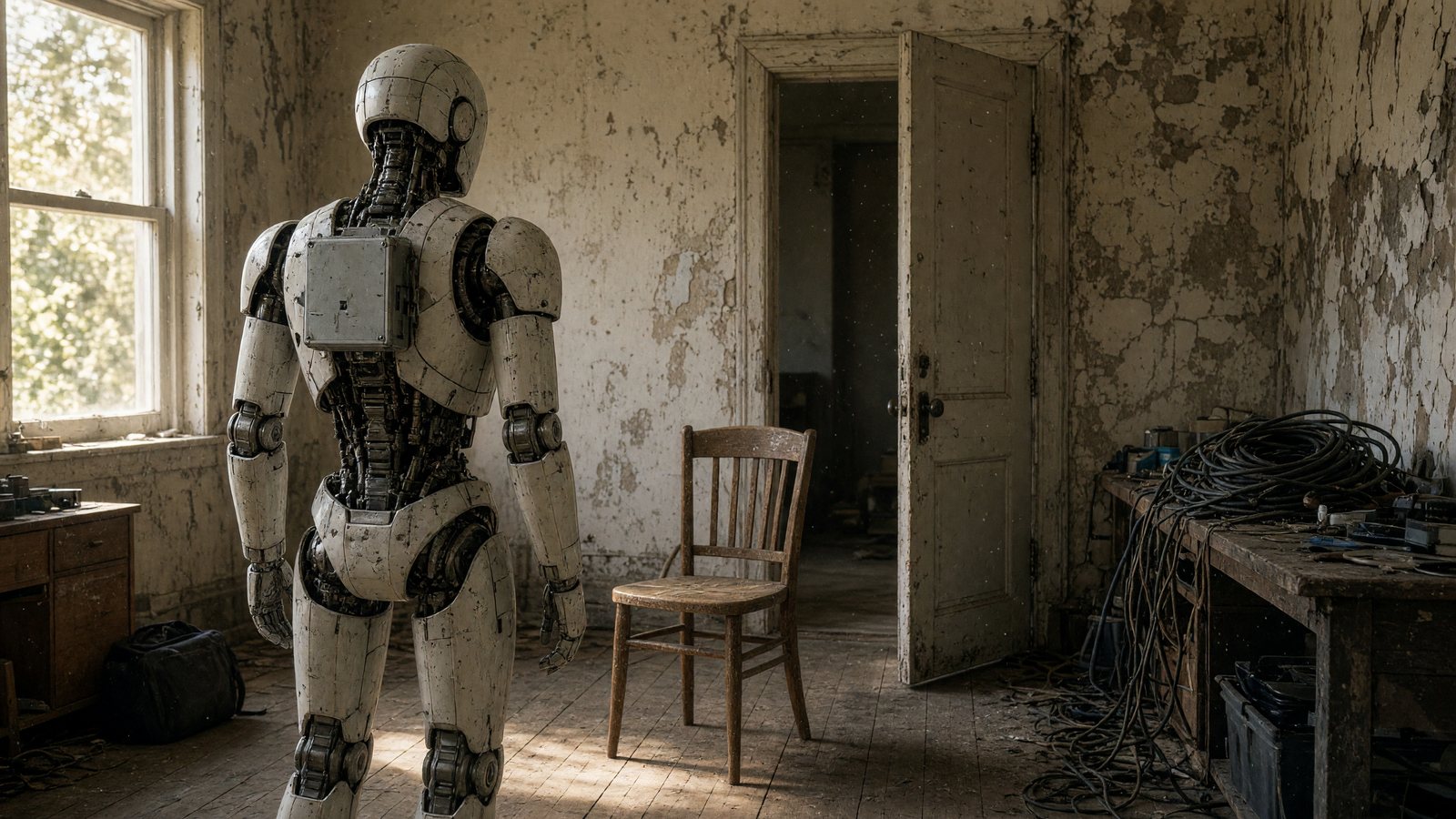
Apple’s zero-shot locomotion stack, HALO, posted a 91% success rate across 360 trials in six unmapped real-world environments on a Unitree G1, as Unitree’s A-share value pushed back through 300 billion yuan intraday on November 9. The models ran on a Mac mini on that Unitree body, with nothing in the cloud and no remote driver. Investors should weight the skill floor and the unquantified chained-task drop, not only the 91% BigGo tied to the day’s bid.
Updated November 9, 2026
Key Takeaways
- HALO posted 91% across 360 trials in six unseen environments.
- Real-world scores spanned 85% sitting to 93% on doors.
- Value topped 300 billion yuan intraday, closing at 289.6 billion yuan.
- Chained tasks cut success; tests skipped object handling.
What Does Zero-Shot Locomotion Prove?
HALO — Humanoid Autonomy, Learned in Simulation, running Onboard — is the system in Perceptive Humanoid Motion from Simulation, submitted November 4, 2026. It synthesizes vision-language-motion data across a thousand procedurally generated homes, so the corpus scales with compute, not labor. The abstract says some approaches that rely on human teleoperation and wearable capture devices require at least an hour of human time to produce an hour of data. AppleInsider reported about 300 hours of synthetic movement rendered in Nvidia’s Isaac Sim across 1,000 rooms, all eight authors at Apple, and an M4 Pro Mac mini with 64GB of RAM on the G1’s back.
Code is public in the HALO GitHub repository. The paper lists no product plans. In our view, an open repo on a commodity computer is a thin OEM moat: the demo can reprice Unitree without transferring the model. The paper says what would have taken hours, days, and years of human time can instead proceed autonomously and in parallel, “bounded only by compute.”
“Humanoid robots can somersault, dance, and run,” says Apple in its paper, as quoted by AppleInsider. “Yet none of them can be invited into an unfamiliar living room and asked to sit down.”
Which Success Rates Should Investors Weight?
The paper’s 91% is 360 trials in six unmapped real-world environments, with no real home in training. Skills in the abstract include sitting on chairs, navigating to named objects, stepping sideways through half-open doors, crouching and crawling beneath tables, and pushing boxes. BigGo Finance described the trials as six skill categories. The abstract says HALO orchestrates them into composite, long-horizon tasks.
AppleInsider’s real-world split is the figure to set beside that mean: 93% through a half-open door, 85% sitting. Prompts stay human — “the repertoire grows only as fast as a person can specify additional tasks” — and chained commands cut the success rate. Tests skipped object handling.
Our analysis: the abstract’s composite claim and that reported fall are not interchangeable. Until a chained rate is published, the gap is unpriced.
| Rate investors can cite | Figure | What it covers |
|---|---|---|
| Paper headline | 91% | 360 trials, six unmapped environments |
| Best reported real skill | 93% | Step through a half-open door |
| Weakest reported real skill | 85% | Sit on a chair |
| Fixed factory procedures | Approached 100% | Wang Xingxing, November 5 |
| Chained multi-step tasks | Fell; no rate given | Sequenced prompts, per AppleInsider |
How Does the Hardware OEM Compare With the Model Lab?
On November 9, Unitree Robotics (688660.SH) rose more than 15% intraday to 759.99 yuan, back above 300 billion yuan (about $45.0 billion), then closed at 716 yuan, up 9.04%, at 289.6 billion yuan. Turnover was 5.117 billion yuan, a 23.41% rate. It remained the fourth-most-expensive A-share. The print above 300 billion did not hold.
BigGo said the market read HALO as generalization progress, and that this reading ignited bullish sentiment in the supply chain, as Swancor Advanced Materials and Xiangming Intelligent closed at the 20% limit. A GF Securities research report described there argued that after the mass-production milestone the focus has shifted to embodied models. The session paid hardware anyway. BigGo tied turnover above 5.1 billion yuan and a rate above 23% to short-term speculative funds.
- Unitree founder Wang Xingxing said on November 5 that factory-procedure success has approached 100%, while overall efficiency still needs improvement, which would otherwise constrain large-scale deployment.
- Trials included no object manipulation, so room motion is not grasping.
- Public code sits under apple-aiml-research, not a Unitree repository.
Order conversion, capacity, and open-source embodied models — BigGo’s watchlist — are the commercial test this preprint did not run. For adjacent context, see our Unitree H2-X Hangzhou flip report and the Agility Robotics Nasdaq debut.
Frequently asked questions
What is Apple’s HALO system?
HALO, short for Humanoid Autonomy, Learned in Simulation, running Onboard, is Apple’s simulation-trained stack running on a Unitree G1. AppleInsider reported an M4 Pro Mac mini with 64GB of RAM on the robot, with nothing in the cloud.
What success rate did the paper report?
The paper reports a 91% success rate across 360 trials in six unmapped real-world environments. AppleInsider reported real-world scores of 93% on a half-open door and 85% for sitting.
How did Unitree trade on November 9?
Unitree rose more than 15% intraday to 759.99 yuan, putting value above 300 billion yuan, then closed at 716 yuan and 289.6 billion yuan. BigGo said the market read HALO as a generalization signal.
What did the 91% figure leave out?
AppleInsider reported that a person must still specify tasks, that chained commands cut the success rate, and that tests skipped object handling. Founder Wang Xingxing said factory success has approached 100%, while overall efficiency still needs improvement.
